15 seconds of input. A complete encounter note.

ENCOUNTERai generates comprehensive clinical documentation trained on your own writing style. Not a template, not a transcription. You describe the patient. HAL writes the note the way you would have.

Clinical Input
Generated Note
Select a scenario and click Generate.
Demonstration only. Production ENCOUNTERai generates notes in 0.6-1.8s.
The Ambient Scribe Trap

Ambient scribes automate the wrong thing.

Every AI ambient scribe on the market, DAX, Nuance, Abridge, Ambience, Suki, DeepScribe, Freed, solves the same problem in the same way. It listens to the visit, transcribes the conversation, and hands the physician a draft to review. The workflow is identical to the dictation services physicians have used since the 1960s. The only thing that changed is who does the typing.

The evidence is damning. 31% of AI-generated ambient notes contain at least one detected hallucination. 84.4% require physician editing before signing. The first randomized clinical trial found users saved just 41 seconds per note, a 9.5% reduction, while DAX Copilot’s savings did not reach statistical significance. AI scribes have increased note length by 20.6% versus traditional documentation, making the bloat crisis worse. Penn Medicine’s Net Promoter Score for AI scribes was exactly zero: 35% promoters and 35% detractors.

ENCOUNTERai doesn’t listen. It predicts. You give it the clinical facts, as much or as little as you want. It generates a complete encounter note in your style, your voice, your structure, in seconds. No hallucinations to catch. No transcription to edit. No 30-year-old workflow dressed in new clothes.

31%
Of AI scribe notes contain hallucinations
41 sec
Average time saved per note by ambient scribes
20.6%
Increase in note length with AI scribes

Sources: Palm et al., Frontiers in AI (2025); Lukac et al., NEJM AI (2025); Duggan et al., JAMA Network Open (2025); UCI Health. Full citations in AHI White Paper Part 2.

The History of Clinical Documentation

Every tool before ENCOUNTERai does the same thing.

Stenographer
1900s
Physician dictates. Stenographer writes shorthand. Physician reviews and signs.
Transcriptionist
1960s
Physician dictates into a tape recorder. Transcriptionist types the note. Physician reviews and signs.
Dragon
1997
Physician speaks. Software transcribes in real time. Physician edits typos and errors before signing.
EHR Templates
2010s
Physician clicks through dropdowns and pre-populated fields. Copies and pastes from prior notes. Physician reviews.
AI Ambient Scribes
2023
Physician and patient talk. AI listens and drafts a note. Physician edits 84.4% of the output before signing.
ENCOUNTERai
2026
Physician provides clinical facts. ENCOUNTERai predicts the complete note in the physician’s own style. Physician reviews and signs in under a minute.
Physician speaks. Machine transcribes. Physician edits.
Physician decides. Machine predicts. Physician signs.
Patient is a 67 year old male presenting with shortness of breath for three days. History of hypertension and type 2 diabetes. Takes metformin and lisinopril. No chest pain. Denies fever. Bilateral crackles on exam, more pronounced on the right. Oxygen saturation 91% on room air. EKG shows sinus rhythm with no ST changes. Will start on Lasix IV and admit to telemetry.
AI Ambient Scribe
ENCOUNTERai

You already know what happened. Why write it twice?

AI scribes listen to your conversation, transcribe it, then ask you to review the transcript. You're narrating your exam findings out loud, editing hallucinated text, and spending more time fixing the note than it would have taken to write it yourself. ENCOUNTERai is different. Tell HAL the clinical facts, as much or as little as you want, and get a complete encounter note in seconds. Assessment, plan, HPI, and ROS generated from your documentation patterns. Physical exam prepopulated from your standard templates. Review the output, tell HAL what to change. "HAL, update the physical exam to include bilateral rales and diminished breath sounds." The note updates instantly. No recording. No narration. No duplicate data.

"45yr male, COVID19, severe cough, fever 103, unvaccinated, difficulty breathing."

That's it. HAL searches your documentation history for the closest clinical match and generates a note that reads like you wrote it.

The 1,500-Hour Dividend

From 1,500 hours a year to 100.

An AMA analysis of 200,000 physicians found they spend 5.8 hours on the EHR for every 8 hours of scheduled patient time. Primary care physicians spend 7.3 hours. Infectious disease physicians spend 8.4, exceeding their scheduled patient time. Extrapolated across a clinical year, that is 1,500 to 1,750 hours annually consumed by documentation. Family physicians additionally log 86 minutes of after-hours pajama time every night. Another 340 hours a year stolen from evenings and families.

ENCOUNTERai reduces note creation from 16 to 36 minutes per encounter to roughly one minute of review and sign. Daily documentation drops from 4 to 6 hours to 25 to 30 minutes. Annual documentation time drops from 1,500 hours to approximately 100. The 1,400 hours returned is not overtime. It is the career coming back.

77% of physicians would trade money for time. The documentation burden, not compensation, is the binding constraint.

Current
Note creation per encounter16-36 minutes
Daily documentation4-6 hours
Annual documentation time1,500 hours
After-hours pajama time86 min/night
Time returned annually0
With ENCOUNTERai
Note creation per encounter~1 minute (review and sign)
Daily documentation~25-30 minutes
Annual documentation time~100 hours
After-hours pajama timeNear zero
Time returned annually~1,400 hours

Sources: Sinsky et al., JGIM (2024); Arndt et al., Annals of Family Medicine (2017); AMA Organizational Biopsy (2024); Doximity (2025). Full citations in AHI White Paper Part 2.

What The Evidence Shows
1,400 hrs
Annual EHR time per physician
86 min
After-hours pajama time per night
62%
Cite documentation as the leading cause of burnout
42.9%
Of physicians wouldn’t choose medicine again

Not a scribe. Not a template. Your documentation DNA.

ENCOUNTERai is trained on your encounter notes, processed through MDMai, to learn how you document. Your word choices. Your clinical reasoning patterns. Your assessment structure. The same clinical input generates different notes for different providers, because no two physicians chart the same way. Physicians who use tools that learn their style stay with them. Generic templates get abandoned.

Clinically complete. Documentation gaps filled. Review and sign.

ENCOUNTERai doesn't just generate what you told it, it fills in what you didn't. If your documentation history shows you always order D-dimer for COVID patients with dyspnea, ENCOUNTERai includes it, even if you didn't mention it. Predictive, not just generative. Every note is built from your MDMai-processed documentation history, so problem complexity, risk language, and clinical reasoning are already there. What used to take 15-20 minutes now takes seconds of input and a quick review.

Prefer an AI scribe? That's built in too.

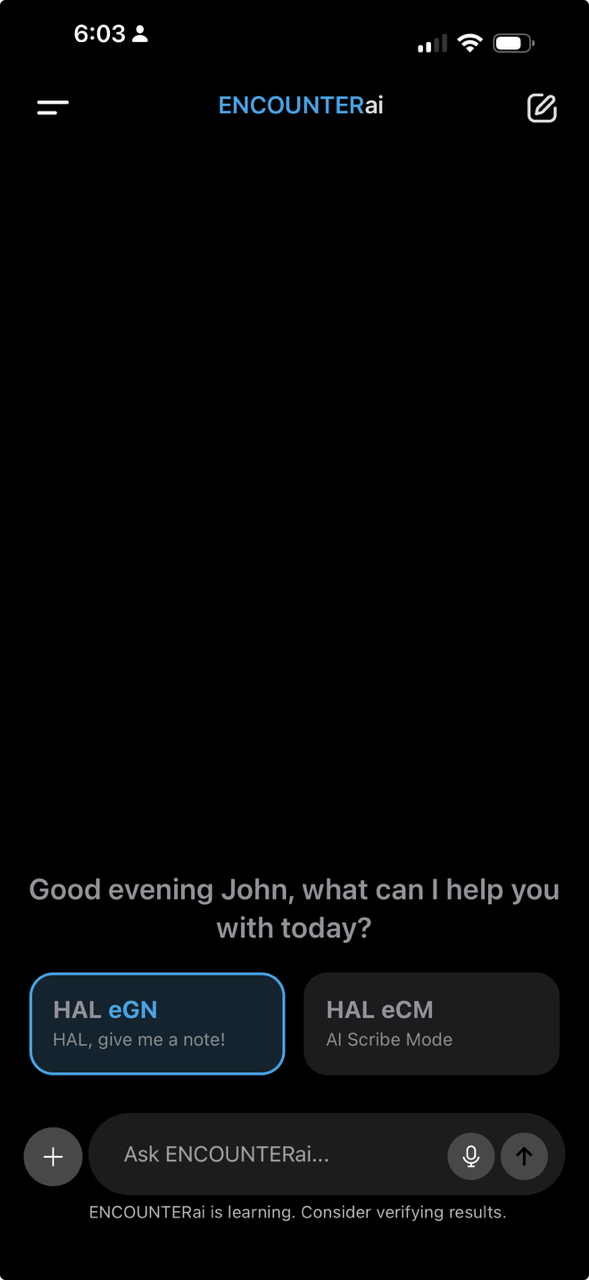
HAL eCM (Encounter Capture Mode) gives you ambient documentation when you want it. But where we differ: if the dictation has gaps, HAL fills them in based on your documentation patterns. Not generic filler. Your clinical voice. And unlike standalone AI scribes, eCM never stores your conversation audio. Two paths. Same result. Choose how you work.

ENCOUNTERai mobile app showing HAL eGN and HAL eCM mode selection

Why we built this

ENCOUNTERai wasn't born from a market report. It was born from watching a board-certified infectious disease specialist come home after a full day of rounding, then spend another 6 to 10 hours creating encounter notes inside an EHR. Templated fields that still need hours of editing. Notes done just well enough to get through the day. Not because she doesn't care, but because the system made it impossible to do better. That's where healthcare breaks. Not at the policy level. Not at the insurance level. At the encounter note. Every downstream problem, denied claims, lost revenue, audit risk, incomplete clinical data, traces back to documentation that was never given the time it deserved. We built ENCOUNTERai to fix the root cause.

Your data. Your model. No exceptions.

Every provider gets their own isolated training pipeline. Your encounter notes train only your model. No other provider can access your data, and your documentation patterns are never shared. No conversation audio is recorded or stored. HIPAA compliant. BAA available. You review every note. You own every note. The AI assists. You decide.

Reclaim your time. Your notes. Your evenings.